Ecommerce Fraud Prevention: The 2026 Playbook
Ecommerce Fraud Prevention: The 2026 Playbook

Start a layered, identity-first fraud stack now: deploy risk scoring at checkout, bot management at the edge, and a chargeback playbook within 72 hours. That single architectural decision, prioritizing identity signals before payment authorization, cuts the majority of card-not-present losses without adding friction for legitimate buyers.
Your 24–72 hour checklist:
- Enable risk scoring at the payment layer (Stripe Radar, your PSP’s built-in rules, or a standalone ML platform)
- Turn on velocity rules: flag accounts placing more than three orders in under 10 minutes or testing cards with sub-$1 charges
- Activate Address Verification Service (AVS) and CVV matching on every transaction
- Set up device fingerprinting on your checkout page
- Open a chargeback dispute folder and start logging device IDs, IP addresses, and AVS/CVV responses per transaction
Vendor categories to evaluate first: payment-layer risk tools (your PSP or Stripe Radar), networked ML platforms (Sift, Riskified), and bot/client-side protection (HUMAN, Imperva). Identity and consortium intelligence platforms like Plaid Protect and Ping Identity come next, once the payment layer is solid.
Key Takeaways
The most effective ecommerce fraud prevention strategy combines identity-first lifecycle scoring, layered technical controls, and forensic evidence collection at transaction time, not after a dispute arrives.
| Point | Details |
|---|---|
| Start at the payment layer | Enable PSP risk scoring, AVS/CVV, and velocity rules within 72 hours — no custom engineering required. |
| Add identity signals next | Device fingerprinting and account-age checks at login and checkout catch ATO and synthetic identity fraud that payment-layer tools miss. |
| Collect forensic evidence now | Log device fingerprints, IP addresses, and AVS/CVV responses per transaction — this evidence wins chargeback disputes. |
| Phase your implementation | Foundation controls in 14 days, signal depth in 45, full lifecycle automation by day 90 — trying to do everything at once stalls progress. |
| Bigdev integrates the full stack | Bigdev builds custom fraud scoring integrations, representment workflows, and PCI DSS v4.0-compliant script monitoring into ecommerce systems from the ground up. |
Table of Contents
- What is ecommerce fraud, and why does it threaten your store’s P&L?
- What types of ecommerce fraud should you know about?
- Warning signs and detection signals you should monitor today
- How does a layered, identity-first prevention strategy actually work?
- Which tool categories cover ecommerce fraud, and what do they each do?
- How do you pick the right fraud solution for your store?
- What does a developer-ready integration checklist look like?
- What fraud trends should you prepare for in 2026?
- What should you do immediately after suspected fraud?
- How should you prioritize fraud prevention actions?
- What does a fraud prevention implementation roadmap look like?
- Why the “fraud vs. conversion” framing is the wrong way to think about this
- Bigdev builds the fraud infrastructure your store actually needs
- Sources
What is ecommerce fraud, and why does it threaten your store’s P&L?
Ecommerce fraud is the deliberate exploitation of an online store’s payment, account, or policy systems to obtain goods, services, or money without legitimate authorization. It breaks into three broad categories: payment fraud (unauthorized card use), account abuse (account takeover and fake-account creation), and policy abuse (friendly fraud, promo manipulation, return fraud). Each category hits your P&L differently, and conflating them leads to the wrong controls.
The financial damage runs deeper than the stolen transaction value. Chargebacks carry fees per dispute, and a chargeback rate above recognized monitoring thresholds can trigger more costly remediation programs. False declines, where your system incorrectly rejects a legitimate buyer, are often a larger revenue leak than fraud itself. The Merchant Risk Council’s Global Payments and Fraud Report tracks both chargeback rates and false-decline rates as core merchant KPIs, and the data consistently shows that over-aggressive blocking destroys conversion during peak sales periods.
Reputational damage compounds the financial hit. A customer whose legitimate order is declined doesn’t usually call to complain. They leave, and they don’t come back.
On the compliance side, PCI DSS v4.0 raises the stakes for client-side script integrity. Merchants must now actively monitor and manage the third-party scripts running on their payment pages, not just secure the server-side transaction. That means Magecart-style formjacking, where attackers inject malicious JavaScript to skim card data in the browser, is now a compliance concern, not just a security concern. Failing to inventory and monitor those scripts puts you outside PCI scope before a single card is stolen.
What types of ecommerce fraud should you know about?
Understanding the full catalog matters because each fraud type requires a different detection signal and a different control. Here are the ten you’ll encounter most:
-
Card-not-present (CNP) / payment fraud. A stolen card number is used to place an order. The cardholder disputes the charge, you lose the goods and the revenue, and you absorb the chargeback fee. CNP fraud is the highest-volume category for most online retailers.
-
Card testing. Fraudsters run dozens or hundreds of small-value authorizations (often $0.00 or $0.99) to verify which stolen card numbers are still active before using them for larger purchases. A sudden spike in micro-authorizations or declines is the clearest signal.
-
Account takeover (ATO). Credential-stuffing bots use breached username/password pairs to log into existing customer accounts, change the shipping address, and place orders. Luxury goods and electronics retailers are primary targets because the resale value is high.
-
New/fake-account fraud. Fraudsters create synthetic or stolen-identity accounts to claim first-order discounts, referral bonuses, or buy-now-pay-later credit. Subscription businesses and marketplaces with new-user incentives are especially exposed.
-
Friendly fraud / first-party chargeback fraud. A real customer makes a legitimate purchase, receives the goods, and then disputes the charge claiming non-delivery or unauthorized use. This is the hardest category to fight because the buyer is real and the transaction looked clean.
-
Promo and discount abuse. Multiple accounts, often bot-generated, claim single-use discount codes, referral credits, or loyalty points. Flash-sale and DTC brands with aggressive acquisition offers see this constantly.
-
Return and refund fraud. Customers return empty boxes, counterfeit items, or used goods while claiming a refund for the original product. Apparel and consumer electronics are the most exposed verticals.
-
Shipping and address fraud. Orders are placed with a legitimate card but shipped to a freight forwarder, reshipping mule address, or a P.O. box used to obscure the final destination. The goods are then resold.
-
Gift-card fraud. Stolen cards fund gift-card purchases, which are then liquidated. Gift cards are attractive because they’re often excluded from standard fraud rules and are difficult to reverse once redeemed.
-
Bot-driven scalping and scraping. Automated bots buy limited-release inventory (sneakers, concert tickets, gaming hardware) the moment it goes live, then resell at a markup. Separately, scrapers harvest pricing data to undercut you competitively. Both degrade site performance and customer experience during high-traffic events.
Warning signs and detection signals you should monitor today
Most fraud leaves a trail before the chargeback arrives. The challenge is knowing where to look and how to connect the dots across your frontend, backend, and payment provider.
Operational red flags to watch:
- IP address doesn’t match billing country or shipping address
- Multiple orders from the same device fingerprint using different card numbers
- Velocity spikes: several orders in minutes from the same IP, email domain, or shipping address
- Repeated small-value authorization attempts (card testing pattern)
- High decline-to-approval ratio on a specific card BIN range
- Account email changed within minutes of a login from a new device (ATO signal)
- Shipping address changed immediately after login, before checkout
- Orders placed at unusual hours for the billing country’s time zone
Google Cloud Fraud Defense demonstrates how correlating signals across registration, login, cart, and payment surfaces attack patterns that single-point detectors miss entirely. An account that was created three minutes ago, logged in from a new device, and is now checking out with an expedited shipping option to a freight forwarder is a very different risk profile than any one of those signals alone.
Detection signal reference:
| Signal | Why it matters | Where to capture it |
|---|---|---|
| IP / billing / shipping mismatch | Indicates card use outside the cardholder’s geography | Payment provider, server-side geolocation |
| Velocity anomaly (orders, declines) | Card testing and account abuse pattern | Backend order management, PSP dashboard |
| Device fingerprint change | Possible ATO or session hijacking | Frontend JS SDK, device intelligence platform |
| AVS / CVV mismatch | Card data is stolen or incomplete | Payment gateway response codes |
| Behavioral anomaly (mouse, typing) | Bot activity or scripted checkout | Client-side behavioral analytics |
| New account + high-value order | Synthetic identity or promo abuse | Backend account-age check at checkout |
| Client-side script change | Possible Magecart injection | Script integrity monitoring (PCI DSS v4.0 scope) |
Imperva’s retail and ecommerce protection specifically addresses the client-side and bot-management layer, noting that checkout pages are the highest-value target for both formjacking and automated card testing.
Pro Tip: Set your velocity rules to alert, not block, for the first two weeks. Review the flagged orders manually to calibrate thresholds before automating declines. Blocking too aggressively from day one is how you reject your best customers during a sale.
How does a layered, identity-first prevention strategy actually work?
The core idea is simple: assess identity risk before you ask for payment, not after. By the time a fraudster reaches your checkout, they’ve already passed through registration and login. If you’re only scoring at the payment step, you’re playing defense on the one-yard line.
Shopify’s fraud management guidance frames this as a five-step playbook: set risk thresholds, add authentication where risk warrants it, automate decisions, build a chargeback response process, and monitor performance continuously. That structure maps directly to a layered stack.
The layered control stack, from edge to post-transaction:
- Edge bot management and WAF: Stop automated attacks before they touch your application. Tools like HUMAN and Imperva operate here, blocking credential-stuffing bots, scalpers, and scrapers at the network edge.
- Client-side script integrity: Monitor every third-party script on your payment page. Under PCI DSS v4.0, you need an inventory of scripts that can access payment fields and active alerting when those scripts change.
- Identity and trust scoring at signup and login: Score new account creation for synthetic identity signals. Score every login for ATO indicators (new device, new IP, credential-stuffing patterns). Platforms like Sift and Ping Identity operate across this lifecycle.
- Step-up authentication (MFA / 3DS): Apply friction surgically. Trigger step-up authentication only when the risk score crosses a threshold, not for every transaction. 3D Secure 2 (3DS2) shifts liability to the card issuer when the challenge is completed, which directly reduces your chargeback exposure.
- Payment gateway rules and AVS/CVV: Your PSP’s built-in rules are the last line before authorization. AVS matching, CVV requirements, and BIN-level velocity rules catch a large share of CNP fraud at near-zero latency.
- Automated decisioning and manual review queue: High-confidence fraud gets auto-declined. High-confidence legitimate orders get auto-approved. Everything in the middle goes to a manual review queue with reason codes attached so your team can make fast, informed decisions.
- Chargeback response process: Collect forensic evidence at the time of every transaction: device fingerprint, IP log, AVS/CVV response, tracking number, and delivery confirmation. That evidence is what wins representment disputes. Per Stripe’s vendor guidance, collecting this data at transaction time, not after a dispute arrives, is the difference between a winnable and an unwinnable chargeback.
Implementation priority by effort and ROI:
- This week: Enable PSP risk scoring, AVS/CVV, and velocity rules. Zero engineering required for most platforms.
- This month: Add device fingerprinting and a manual review queue with reason codes.
- This quarter: Implement a networked ML platform, 3DS2 for high-risk segments, and client-side script monitoring.
- Medium-term: Full lifecycle identity scoring (signup → login → checkout) and automated chargeback representment.
Pro Tip: Apply 3DS2 step-up only to orders above your average order value or to accounts with a low trust score. Blanket 3DS on every transaction adds friction that measurably reduces conversion for your best customers.
Which tool categories cover ecommerce fraud, and what do they each do?
No single vendor covers every fraud type across every lifecycle stage. The market breaks into five distinct categories, and most mid-market stores need at least two of them working together.
Payment-provider / PSP fraud tools
Your payment processor likely includes basic fraud scoring. Stripe Radar uses signals from Stripe’s global transaction network to score each payment in real time, applying machine-learning rules that benefit from the scale of the entire Stripe network. These tools are fast to deploy (often zero integration work), but their lifecycle coverage stops at the payment step. They don’t see what happened at signup or login.
Networked ML fraud platforms
Platforms like Sift and Riskified operate across the full user lifecycle and train on cross-merchant transaction data, which means their models have seen attack patterns from thousands of stores before your fraudster tries them on you. Riskified offers a chargeback guarantee model, where they take liability for approved orders, which shifts the financial risk entirely. Sift provides reason codes and a case management interface for manual review teams. Amazon Fraud Detector sits in this category too, offering ML-based fraud predictions with a free tier covering up to 30,000 predictions per month under certain configurations, making it accessible for stores that want to build custom models on AWS infrastructure.
Bot management and client-side protection
HUMAN (formerly White Ops) and Imperva specialize in distinguishing automated traffic from human traffic. HUMAN’s network claims to analyze trillions of signals to identify bot activity across its customer base. Imperva’s retail-focused offering covers both WAF protection and client-side script integrity, which is directly relevant to PCI DSS v4.0 compliance. These tools protect your checkout page from Magecart injection and stop card-testing bots before they generate a single authorization.
Identity and consortium intelligence platforms
Ping Identity and Plaid Protect operate on identity signals rather than transaction signals. Plaid Protect uses cross-application financial signals, drawing on account activity across thousands of connected financial apps, to generate dynamic trust scores. This consortium approach catches synthetic identities and mule accounts that look clean in isolation but show anomalous patterns across the broader financial network. Ping Identity focuses on authentication and access management, adding MFA and risk-based authentication to the login layer.
Chargeback guarantee providers
Some platforms (Riskified being the clearest example) offer to approve orders and absorb chargeback liability entirely. You pay a fee per transaction; they take the risk. This model works well for high-volume merchants who want predictable fraud costs and are willing to trade some margin for certainty.
When to evaluate each category:
- High-volume merchants with engineering resources: networked ML platform plus bot management
- SMBs on Stripe or Shopify: start with the PSP’s built-in tools, add a bot management layer for checkout
- Businesses with complex login flows or subscription models: identity platform (Ping Identity, Sift) at the account layer
- Stores with significant new-account incentives: consortium intelligence (Plaid Protect) to catch synthetic identities
- Merchants who want zero chargeback liability: chargeback guarantee provider
How do you pick the right fraud solution for your store?
The vendor landscape is crowded, and every platform claims to reduce fraud without hurting conversion. The questions below cut through the marketing.
Vendor questions checklist:
- What is your decision latency? (Target: under 300ms for real-time checkout scoring)
- How large is your transaction network, and what verticals does it cover?
- Does your coverage span the full user lifecycle (signup, login, cart, payment, post-purchase)?
- What reason codes do you provide, and can they trigger automated responses?
- How complex is the integration? (SDK, API, or PSP plugin?)
- Do you offer chargeback support or guarantee options?
- How is pricing structured? (Per-transaction, monthly seat, percentage of GMV, or tiered volume?)
- Can you provide backtesting on our historical transaction data before we commit?
Key tradeoffs to weigh:
| Decision | Option A | Option B |
|---|---|---|
| Conversion vs. false-decline risk | Aggressive blocking (lower fraud, more false declines) | Permissive scoring (higher approval, more fraud) |
| Control vs. managed liability | Rules-based with your team managing decisions | Chargeback guarantee (vendor takes liability) |
| Speed to deploy vs. signal depth | PSP built-in tools (hours to deploy, limited signals) | Networked ML platform (days to weeks, richer signals) |
| Transparency vs. model complexity | Rules engine with full explainability | Black-box ML (better accuracy, harder to audit) |
Stripe’s guidance on fraud software selection recommends evaluating decision latency, integration complexity, and data-network coverage as the three primary axes. A platform with a massive transaction network but a 2-second decision latency is a poor fit for a checkout flow where speed directly affects conversion.
For pilot tests, request a 30-day backtest on your historical orders. Ask for approval lift (how many legitimate orders would have been approved that your current setup declines), chargeback reduction rate, and false-positive rate on known-good customers. Those three numbers tell you more than any sales deck.
What does a developer-ready integration checklist look like?
Technical teams need specifics, not principles. Here’s a phased integration plan that balances signal depth with deployment speed.
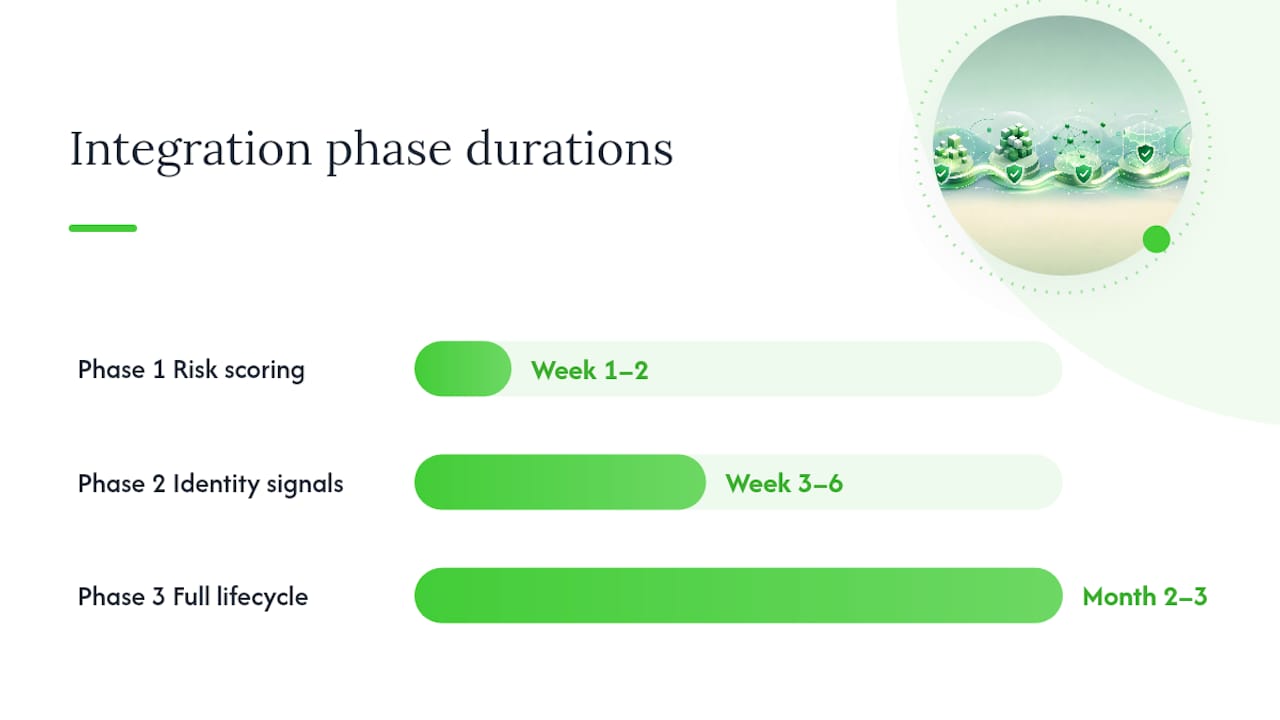
Phase 1: Risk scoring and basic bot protection (Week 1–2)
- Instrument server-side risk scoring at the payment authorization step. Pass device fingerprint, IP, email, and order value to your scoring API before calling the payment gateway.
- Set decision latency targets: under 200ms for auto-approve/decline, up to 500ms for manual-review routing.
- Enable AVS and CVV checks at the gateway level and log every response code.
- Deploy a WAF rule set at the edge (Cloudflare, AWS WAF, or Imperva) to block known bad IP ranges and rate-limit checkout endpoints.
- Start logging: device fingerprint, IP, user agent, session ID, AVS/CVV response, and order outcome for every transaction.
Phase 2: Identity signals and reason codes (Week 3–6)
- Add a client-side SDK for device intelligence and behavioral analytics on your checkout and login pages.
- Integrate reason codes from your fraud platform into your order management system so manual reviewers see structured signals, not raw scores.
- Implement account-age and account-activity checks at checkout: flag accounts created in the last 24 hours placing orders above your average order value.
- Connect login events to your fraud platform so ATO signals (new device, new IP, failed login spike) feed into checkout scoring.
Phase 3: Full lifecycle correlation and automated representment (Month 2–3)
- Correlate signals across the full user journey: registration, email verification, login, cart, checkout, and post-purchase behavior.
- Automate chargeback representment workflows: when a dispute arrives, your system should automatically pull the transaction’s device fingerprint, IP log, AVS/CVV response, delivery confirmation, and reason codes into a dispute package.
- Implement 3DS2 step-up for orders above your risk threshold or average order value.
- Audit your payment page scripts against PCI DSS v4.0 requirements: maintain an inventory of every third-party script that can access payment fields, and set up integrity monitoring (Subresource Integrity hashes or a dedicated script-monitoring tool).
Key developer considerations:
- Handle API timeouts gracefully: if your fraud scoring API times out, default to a soft-approve with manual review flag rather than a hard decline or a hard approve.
- Store forensic evidence at transaction time, not on dispute receipt. By the time a chargeback arrives, 60–120 days may have passed and session data may be gone.
- Separate your fraud logging pipeline from your application database to prevent evidence tampering and to meet dispute documentation requirements.
Pro Tip: Payment gateways alone do not protect against Magecart/formjacking. A malicious script injected into your checkout page skims card data in the browser before it ever reaches your gateway’s encryption. PCI DSS v4.0 requires active script monitoring, and tools like Imperva’s client-side protection or a Subresource Integrity policy on your payment scripts are the practical answer.
What fraud trends should you prepare for in 2026?
The threat surface is shifting fast. Here’s what’s moving and what to do about it.
-
Agentic web and AI-driven bots. Fraud bots are increasingly capable of solving CAPTCHAs, mimicking human behavioral patterns, and adapting to detection rules in near-real time. Static CAPTCHA defenses are losing ground. Evaluate bot management vendors on their behavioral and intent-based detection, not just their CAPTCHA bypass rates. In the next 6–12 months, prioritize vendors who publish detection accuracy against AI-generated bot traffic.
-
Cross-merchant consortium signals. The most durable fraud detection advantage comes from seeing attack patterns across thousands of merchants simultaneously. Platforms that pool signals across their customer base, like Sift’s network and Plaid Protect’s cross-application financial data catch fraud that isolated models miss. Evaluate whether your current vendor’s network is growing and whether it covers your vertical.
-
Identity-first scoring as the default architecture. The industry is moving away from transaction-level scoring toward continuous identity assessment across the full user lifecycle. Google Cloud Fraud Defense’s journey-correlation approach, linking registration through payment, represents where the market is heading. If your current stack only scores at checkout, plan a migration to lifecycle-aware scoring within the next 12 months.
-
API and server-side protection emphasis. As more checkout flows move to headless and API-first architectures, fraud controls need to operate at the API layer, not just on rendered pages. Ensure your fraud scoring integrates with your API gateway, not just your frontend checkout component.
-
Client-side script integrity as a compliance mandate. PCI DSS v4.0 is already in effect, and enforcement focus on client-side script monitoring will intensify. Merchants who haven’t inventoried their payment-page scripts are carrying both a compliance gap and a live attack surface. Adopt a script integrity policy now, before an audit or an incident forces the issue.
What should you do immediately after suspected fraud?
Speed matters. The window to stop a fraudulent order before it ships is often measured in hours.
Immediate response steps (within the first hour):
- Place the order on manual hold in your order management system before it enters fulfillment.
- Pull the full transaction record: device fingerprint, IP address, email, shipping address, AVS/CVV response, and account creation date.
- Check the shipping address against known freight-forwarder databases and reshipping mule address lists (several fraud platforms maintain these).
- Contact your payment processor to flag the transaction. If the card is confirmed stolen, initiate a void or refund before the goods ship.
- If the order has already shipped, file a package intercept request with the carrier immediately.
Reporting and documentation:
- Log the incident in your fraud case management system with all evidence attached.
- If the fraud involves identity theft or organized fraud rings, file a report with the IC3 (Internet Crime Complaint Center). IC3 advisories document evolving online fraud patterns, and merchant reports contribute to coordinated law enforcement responses.
- Preserve all logs for at least 13 months to cover potential chargeback dispute windows.
Chargeback response (when the dispute arrives):
Gather your pre-collected forensic package: device fingerprint, IP log, AVS/CVV match confirmation, delivery tracking with signature, and any behavioral analytics showing human interaction with the checkout. A well-documented representment package significantly improves your win rate. Per Stripe’s guidance, collecting this evidence at transaction time is what makes the difference between a winnable and an unwinnable dispute.
How should you prioritize fraud prevention actions?
Not every control delivers equal ROI, and trying to implement everything at once is how projects stall. Here’s a framework that maps effort to impact.
Immediate priority (highest impact, lowest effort):
These controls require no custom engineering and stop the majority of opportunistic fraud. Enable PSP risk scoring, AVS/CVV matching, and velocity rules. Set up a manual review queue. Start logging forensic evidence per transaction. Most merchants can complete this tier in under a week using their existing payment platform.
Short-term priority (high impact, moderate effort):
Add device fingerprinting and a client-side behavioral analytics SDK. Implement account-age checks at checkout. Deploy a WAF at the edge. These controls require some engineering time but deliver measurable reductions in card testing and ATO attempts. Target completion within 30 days.
Medium-term priority (strategic impact, higher effort):
Full lifecycle identity scoring, 3DS2 step-up authentication, automated chargeback representment, and client-side script integrity monitoring under PCI DSS v4.0. These require deeper integration work and possibly a new vendor relationship, but they’re what separates a reactive fraud program from a proactive one. Plan for a 60–90 day implementation window.
Ongoing monitoring (continuous):
Review your chargeback rate, false-decline rate, and manual review queue volume weekly. Adjust velocity thresholds and risk score cutoffs based on what you see. Fraud patterns shift, and a rule set that was calibrated six months ago may be over-blocking or under-blocking today.
What does a fraud prevention implementation roadmap look like?
A phased roadmap prevents the common failure mode: trying to implement everything simultaneously and finishing nothing.
Phase 1: Foundation (Days 1–14)
Goal: Stop the most common, highest-volume fraud with minimal engineering.
- Enable PSP fraud scoring and AVS/CVV requirements
- Set velocity rules (order count, decline count, card-per-account limits)
- Open a manual review queue and assign ownership
- Begin logging forensic evidence per transaction
- Deploy edge WAF rules
Expected outcome: Immediate reduction in card testing and opportunistic CNP fraud. Manual review queue gives your team visibility before you automate.
Phase 2: Signal depth (Days 15–45)
Goal: Add identity and behavioral signals to reduce false declines and catch ATO.
- Integrate device fingerprinting SDK on checkout and login pages
- Connect login events to fraud scoring (ATO signals)
- Implement account-age and account-activity checks
- Add reason codes to your order management system
- Evaluate and pilot a networked ML platform against your historical data
Expected outcome: Measurable reduction in ATO-driven chargebacks and improved manual review efficiency from structured reason codes.
Phase 3: Lifecycle coverage and automation (Days 46–90)
Goal: Correlate signals across the full user journey and automate high-confidence decisions.
- Deploy full lifecycle scoring (signup → login → checkout)
- Implement 3DS2 step-up for high-risk segments
- Automate chargeback representment workflows
- Complete PCI DSS v4.0 client-side script audit and implement integrity monitoring
- Set up continuous performance monitoring (chargeback rate, false-decline rate, approval lift)
Expected outcome: A self-improving fraud program with automated decisioning on the majority of orders and a documented compliance posture for PCI DSS v4.0.
Why the “fraud vs. conversion” framing is the wrong way to think about this
Most fraud prevention conversations get framed as a tradeoff: tighten controls and lose revenue, or loosen them and absorb fraud losses. That framing is wrong, and it leads merchants to under-invest in detection while over-investing in blunt blocking rules.
The real cost isn’t the fraud you catch. It’s the legitimate customers you reject. A false decline on a high-value, repeat customer costs you that transaction, that customer’s lifetime value, and the word-of-mouth they would have generated. Blunt IP-country blocking, blanket velocity rules, and site-wide 3DS mandates all produce false declines at scale, and they do it invisibly because declined customers rarely complain.
Identity-first scoring inverts this. When you know who a buyer is before they reach checkout, because you’ve been building a trust profile since they created their account, you can approve high-confidence legitimate buyers instantly and apply friction only where the risk signal actually warrants it. That’s not a security tradeoff. It’s a conversion improvement that happens to also reduce fraud.
The merchants who treat fraud prevention as a revenue enabler, rather than a cost center, are the ones who invest in networked ML platforms, lifecycle identity scoring, and reason-code-driven automation. They approve more legitimate orders, dispute chargebacks with better evidence, and spend less on manual review labor. The math works in their favor.
Bigdev builds the fraud infrastructure your store actually needs
Fraud prevention only works when it’s built into your store’s architecture from the start, not bolted on after a chargeback spike. Bigdev designs and builds custom ecommerce systems with fraud controls integrated at every layer: server-side risk scoring APIs, device fingerprinting SDKs, automated chargeback representment workflows, and PCI DSS v4.0-compliant script integrity monitoring.

Where most development projects treat fraud as a payment-gateway checkbox, Bigdev treats it as a system design requirement. Every ecommerce build includes a fraud integration plan, a logging architecture for forensic evidence, and a manual review workflow that your team can actually use. If you’re running on a platform that wasn’t built with these controls in mind, Bigdev can audit your current setup and build the missing layers without a full rebuild.
Specific services that map to this playbook:
- Custom fraud scoring API integrations (Stripe Radar, Sift, Amazon Fraud Detector, Google Cloud Fraud Defense)
- Device fingerprinting and behavioral analytics SDK implementation
- Automated chargeback representment workflow development
- Client-side script integrity monitoring and PCI DSS v4.0 compliance builds
- Bot management and WAF configuration for ecommerce checkout flows
Bigdev and describe your current fraud exposure. Michał will respond with a scoped integration plan, not a sales deck.
Sources
- PCI Security Standards Council
- How to Pick Ecommerce Fraud Prevention Software | Stripe
- Ecommerce Fraud Management in the AI Era: A 2026 Guide - Shopify
- IC3 public safety advisory 2025